
What Connecticut and Rhode Island drivers should know before winter arrives.
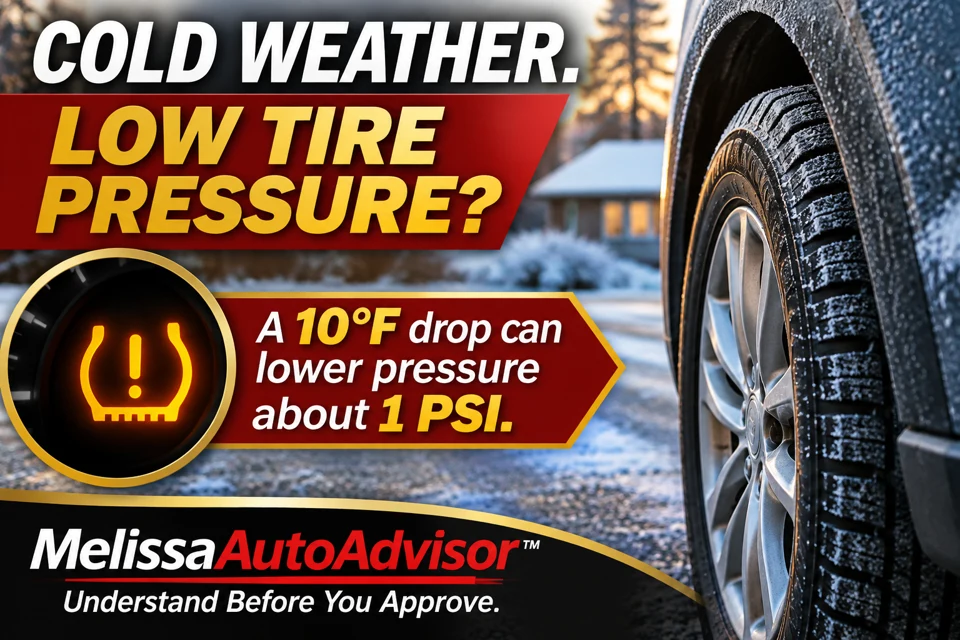
You walk outside on a chilly November morning, start your vehicle, and see the tire pressure warning light. Yesterday everything seemed fine. Did you suddenly get a flat tire? Not necessarily: falling temperatures may be responsible.
As the air inside a tire gets colder, its pressure decreases. A useful rule of thumb is about 1 PSI for each 10°F drop in temperature. If the temperature falls from 70°F to 30°F, tire pressure may drop around 4 PSI even without a puncture. That can be enough to trigger the Tire Pressure Monitoring System (TPMS) warning.
No. Even when the weather caused the drop, the tires may need air. Underinflation can affect handling, fuel economy and tire wear. If a tire looks flat or the vehicle behaves abnormally, stop in a safe place and get assistance.
Use the vehicle manufacturer's recommended cold tire pressure on the driver's door-jamb placard or in the owner's manual. Do not use the maximum pressure molded into the tire sidewall as the normal inflation target.
Check tire pressures before driving, ideally after the vehicle has been parked for at least three hours. Check all four tires and the spare if equipped. If you add air after driving, recheck when the tires are cold.
A recurring warning—especially when one tire loses pressure faster than the others—can indicate a puncture, leaking valve, bead-seal leak or wheel damage. Cold weather can reveal an existing slow leak, but it does not explain every warning. If the pressures are correct and the light persists, consult the owner's manual for the TPMS reset procedure or arrange a system inspection.
Before assuming you need a tire or a TPMS sensor, start with an accurate pressure check. Ask the shop what was measured and whether there is evidence of a leak. A warning light tells you something needs attention; it does not automatically identify the failed part.
Explore the AutoAdvisor Mini Guides and the Consumer Auto Repair Survival System™ to learn what to ask before authorizing vehicle repairs.